Ask naturally
Ask what a word means here, why a correction was made, how to say something naturally, or what to practise. Follow-up questions stay in the conversation. You can also attach photos of notes or a page.
AI TUTOR · DICTIONARY · ADAPTIVE FLASHCARDS
Repertoire is a general-purpose language-learning assistant. Ask about a phrase from a book, a line in a film, something you want to say, or a correction from a lesson. It explains what matters, remembers it in context, and turns it into practice you can return to. Everything else you do to learn becomes more useful.
Keep learning however you want. Repertoire helps it carry forward.
FROM A REAL LEARNING MOMENT
“What does umständlich mean in Das ist mir zu umständlich?”
Here, umständlich means more complicated or cumbersome than it needs to be.
The expression stays in your Library and comes back in a contextual flashcard. Later practice can help you use it in a new situation.
Illustrative Repertoire learning journey.
MORE THAN A LOOKUP
A word from a book, an explanation from class, and a phrase you tried in conversation can all become part of one personal repertoire. Repertoire connects the immediate answer to your notes, flashcards and later practice, so each effort can build on the last.
HOW IT FITS TOGETHER
AI assistants are useful for asking questions. Flashcard apps are useful for review. Repertoire connects the answer, what you keep, and the practice that follows—around the language you are actually learning.
Swipe the table to compare →
| Learning step | General AI assistant | Flashcard app | Repertoire |
|---|---|---|---|
| Ask and explore | Conversational explanations and follow-up questions | Review or edit the material on a card | Language-focused tutoring with examples and follow-ups |
| Keep the useful part | Chat history and saved study aids | Cards organised in decks | Editable Library notes with examples and your context |
| Return to it | Quizzes or saved flashcards | Scheduled card reviews | Contextual flashcards with adaptive review timing |
| Put it to use | Ask for a practice activity | Recall the answer on a card | Reading, writing and exercises connected to what you saved |
| See progress | Conversation or quiz history | Card review history and statistics | A path from encountered to practising, familiar and active |
Reference workflows: ChatGPT Study and ChatGPT Flashcards for conversational study; the Anki review scheduler for card reviews.
ONE CONNECTED LEARNING LOOP
Start with anything you are learning. The tutor connects the answer to a personal record and a next step.
Ask what a word means here, why a correction was made, how to say something naturally, or what to practise. Follow-up questions stay in the conversation. You can also attach photos of notes or a page.
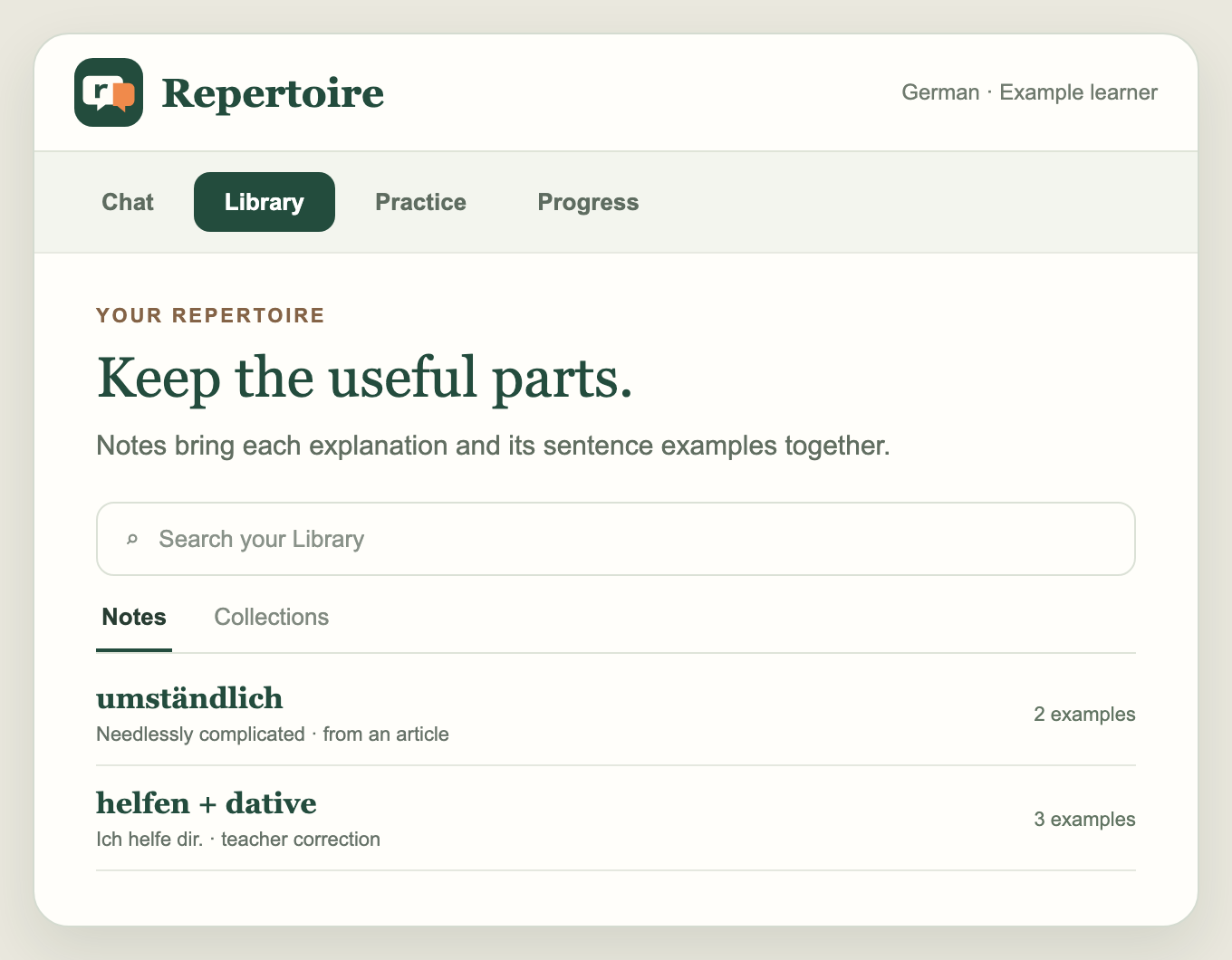
Repertoire saves suitable explanations as editable notes with examples in your Library. Your own context can stay attached, so a useful discovery does not end with one chat.
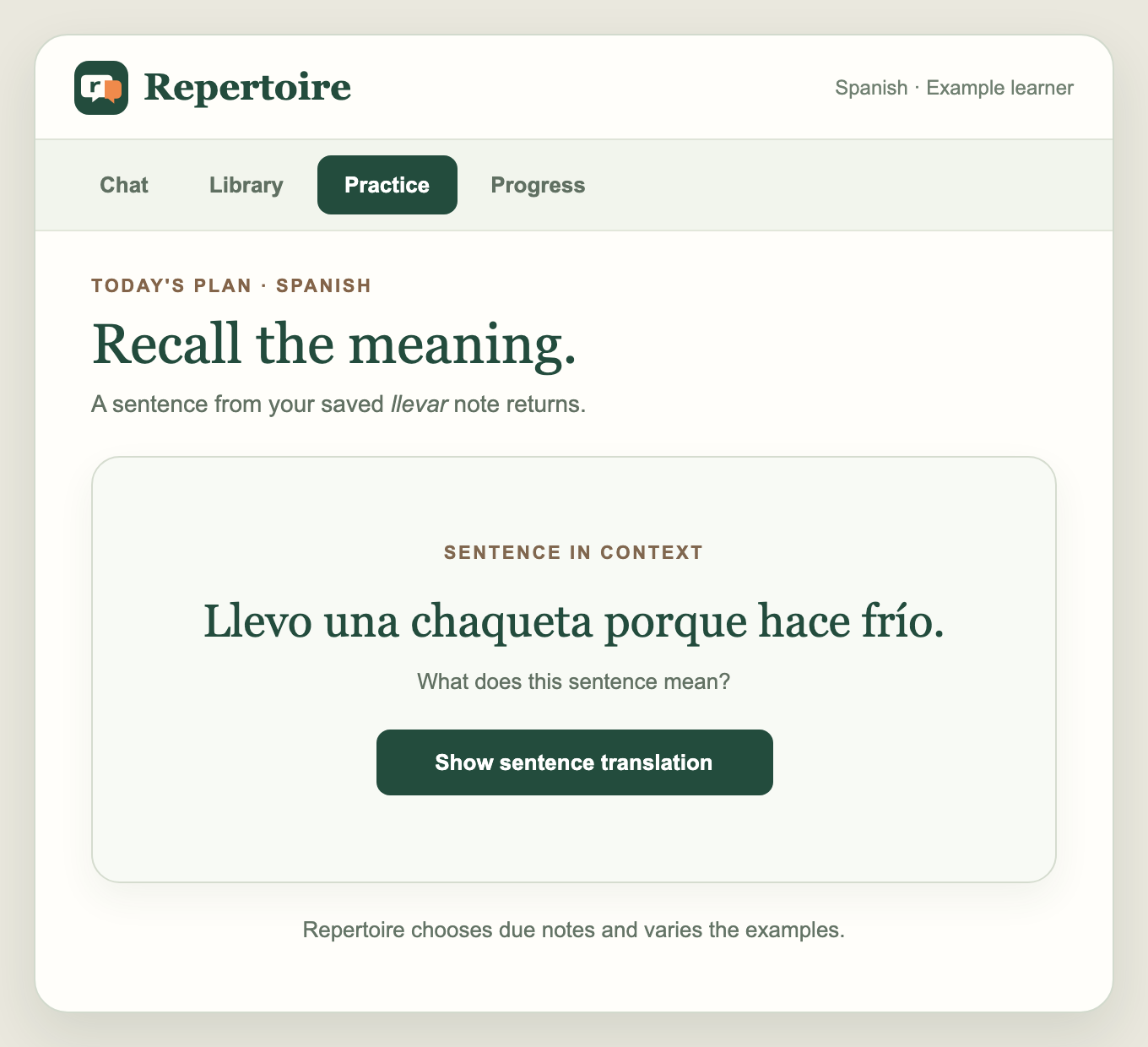
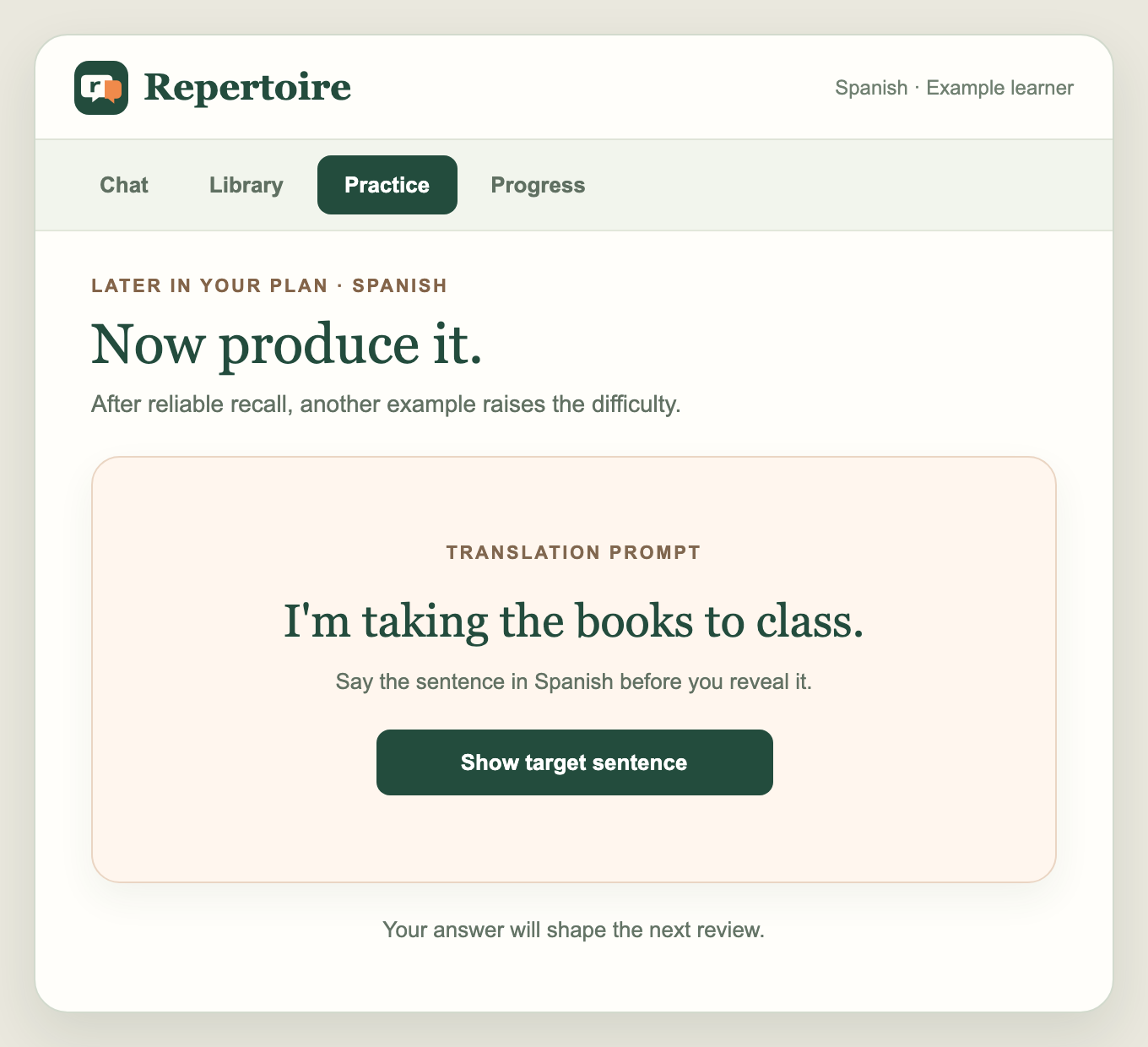
Contextual flashcards return across days. Your recall ratings help schedule reviews; practice can move from recognising a meaning toward producing a sentence. Writing, reading and exercise sets offer other ways to use what you met.
Progress reflects encounters and practice, keeping a first lookup distinct from stronger evidence that you can recall or use an expression.
EXAMPLE LEARNING JOURNEYS
Start with what you are already reading, studying or trying to say. Each example shows how one moment can carry into later practice.
JOURNEY 01
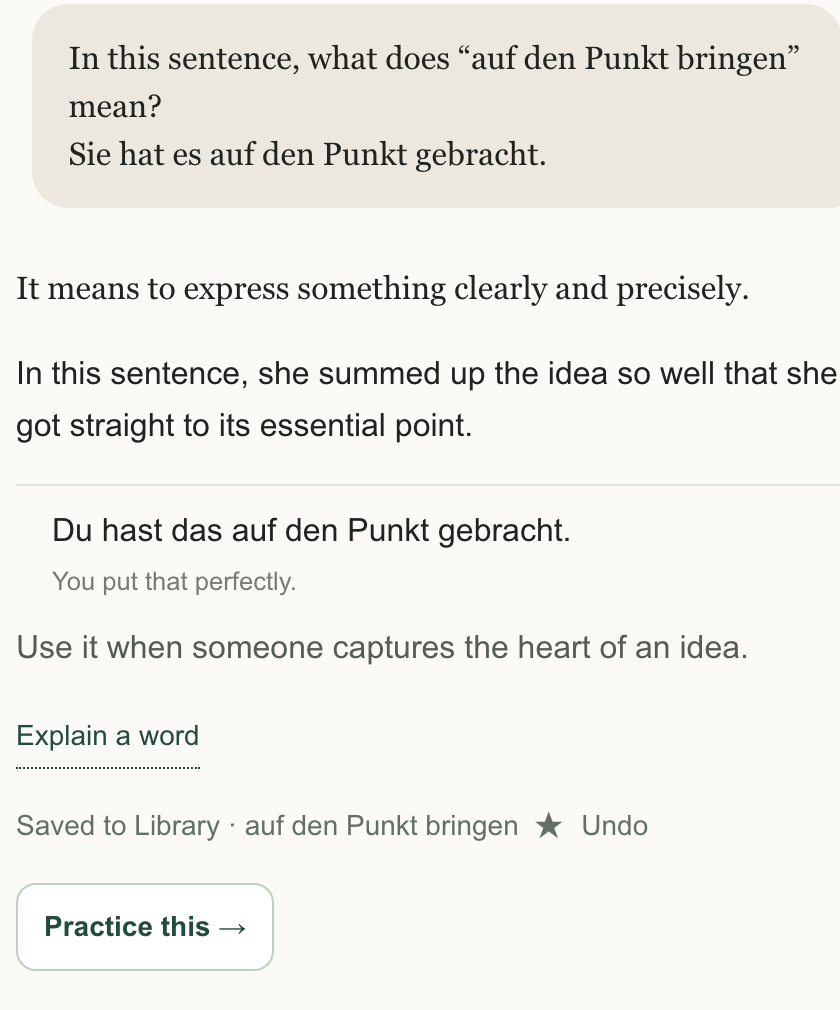
You meet “auf den Punkt bringen” in a sentence and want to know what it means here.
JOURNEY 02
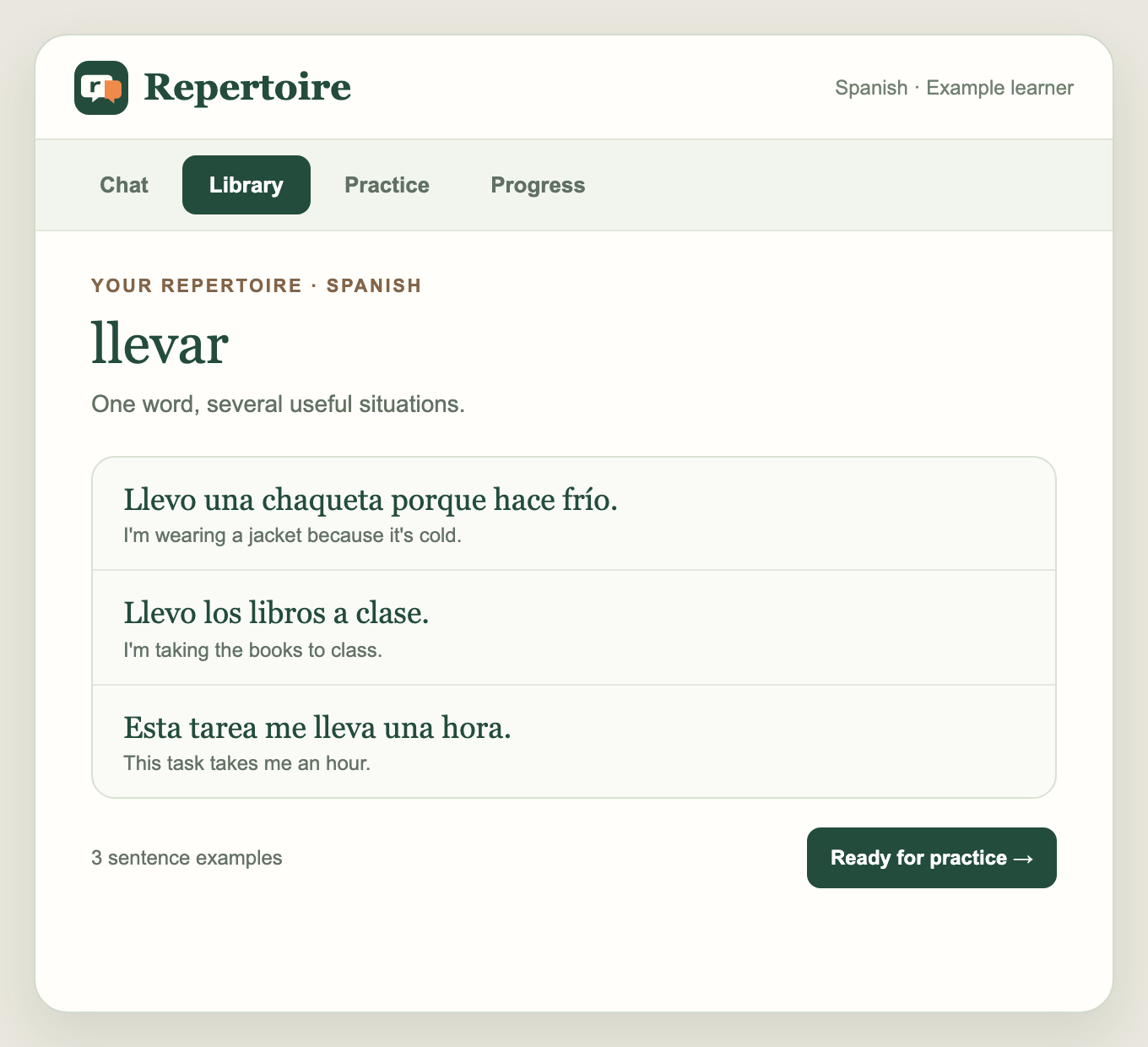
You encounter the Spanish verb “llevar” in different situations. One translation is not enough.
Swipe through the screenshots →
JOURNEY 03
A teacher changes “Ich helfe dich” to “Ich helfe dir.” You want to understand the pattern, not just copy the answer.
JOURNEY 04
After questions, notes and reviews, you want to see what you have encountered and what you can use.
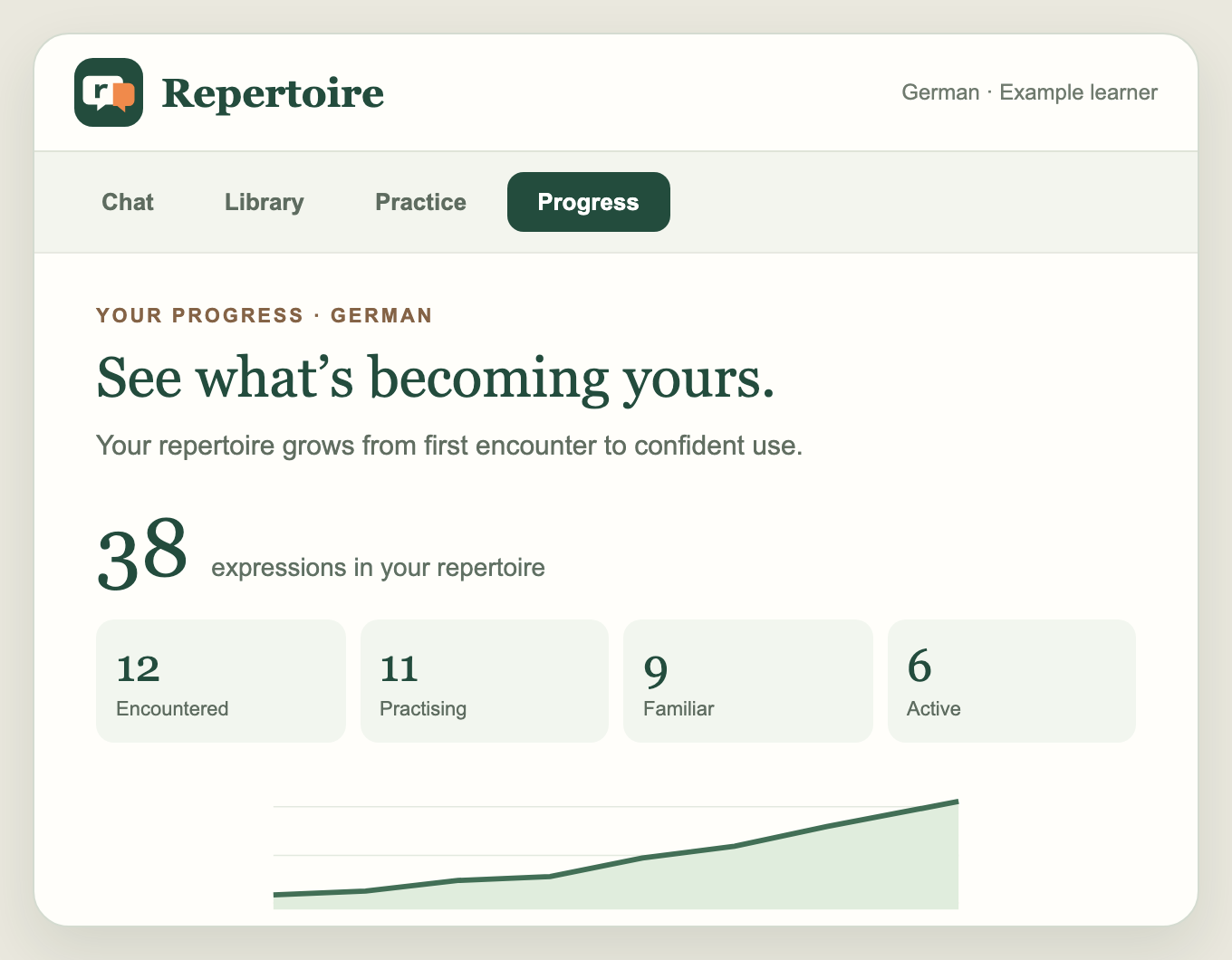
Illustrative Repertoire screens with example content. Open a screenshot to see it at full size.
LEARN HOWEVER YOU WANT
Bring the words and questions that come up while reading, watching, speaking or writing. Ask what something means in context, follow your curiosity, and revisit the useful parts through flashcards, reading and writing practice.
Bring material from a course, another app, a textbook or a teacher. Scan notes, ask about a correction, or make an exercise set. You can also organise notes in collections and share them with a learning partner or classmates.
AT A GLANCE
Repertoire uses AI for explanations and some feedback. Read the privacy policy for how learning content and photos are handled.
EARLY ACCESS
Join the list for web or iPhone access. Tell us which language you are learning after you add your email.